TL;DR: Yes, statistically. As a population, the average mestizo Mexican is roughly 60% Native American by ancestry, sometimes more, with the rest mostly European and a smaller amount of African. Traced through the maternal line alone, that Indigenous figure climbs past 85%. So genetically, the typical Mexican is more Native American than anything else. Whether that makes someone “Native American” in the legal or self-identified sense is a separate question, and that is where it gets interesting.
Short version: most Mexicans carry substantial Native American ancestry, often a majority of it, but “Native American” means different things depending on whether you are talking about genetics, legal status, or personal identity. The question only sounds simple. Untangling it means separating three things that usually get mashed together: what your DNA says, what a government recognizes, and what you call yourself.
Get those three straight and the confusion mostly disappears. So let me take them one at a time.
The Quick Answer, Three Ways
Genetically: Yes, largely. The average mestizo Mexican carries roughly half Indigenous American ancestry, sometimes considerably more, alongside European and smaller amounts of African ancestry. The Indigenous component is real, deep, and traceable to specific regions of Mexico.
Legally and politically: Usually no, at least not in the way the term works in the United States. “Native American” as a legal category in the US means enrollment in a federally recognized tribe, and that is a political and administrative status, not a DNA percentage. Most Mexicans do not hold it.
By identity: It depends entirely on the person. Some Mexicans identify strongly as Indigenous, speak an Indigenous language, and belong to a living community. Others see themselves as mestizo, or simply as Mexican, with Indigenous heritage sitting somewhere in the background.
All three of those can be true about the same person at the same time. That is the whole knot, and it is why the internet argues about this endlessly. Now the details.
What “Native American” Actually Means
Part of the trouble is that “Native American” is doing two completely different jobs in everyday conversation.
One job is ancestral: descended from the peoples who lived in the Americas before European contact. By that definition, the Indigenous peoples of Mexico, the Nahua, Maya, Zapotec, Mixtec, Purépecha, Otomí, and dozens of others, are Native American in exactly the same sense as the Indigenous peoples north of the Rio Grande. The border between the US and Mexico is about 180 years old. The peoples it runs through are thousands of years old. Genetics does not stop at a customs checkpoint.
The other job is legal and national: “Native American” as shorthand for the recognized tribal nations within the United States, with all the specific political status that carries. This is where Mexicans generally fall outside the term, not because of ancestry but because tribal enrollment is a citizenship-like status tied to particular nations, most of them inside US borders.
When someone says “Mexicans aren’t Native American,” they are almost always using the second definition. When someone says “of course they are,” they are usually using the first. Both are right within their own frame, which is why the argument never resolves. It is a definitions problem wearing the costume of a factual dispute.
The Genetics: What the Studies Actually Show
Here is where it gets genuinely interesting, and where the anthropology pays off.
Mexicans are, as a population, primarily the descendants of Indigenous Americans and Europeans, with African ancestry mixed in from the colonial period. That is the textbook definition of a mestizo population, and it is not a vague cultural claim. It shows up cleanly in the DNA.
Large genomic studies of Mexican and Mexican American populations consistently find that Native American ancestry makes up a substantial share of the mestizo genome, frequently around half and often more, depending on the region and the individual. The maternal line tells an even more lopsided story. When researchers sequenced hundreds of Mexican American mitochondrial genomes, which track ancestry through the direct female line, the large majority belonged to Native American founder lineages, the haplogroups labeled A2, B2, C1, and D. European maternal lineages were a distinct minority, and African ones a small fraction.
That maternal skew is not random, and it points straight at history. The colonial admixture was sexually asymmetric: it happened overwhelmingly through European men and Indigenous women. So the Y chromosome, passed father to son, leans heavily European, while mitochondrial DNA, passed mother to child, leans overwhelmingly Indigenous. The genome carries the demographic signature of the conquest written into two different inheritance streams. As someone who spent a good chunk of an anthropology minor fascinated by exactly this kind of thing, I find it hard to think of a cleaner example of history leaving a molecular fingerprint.
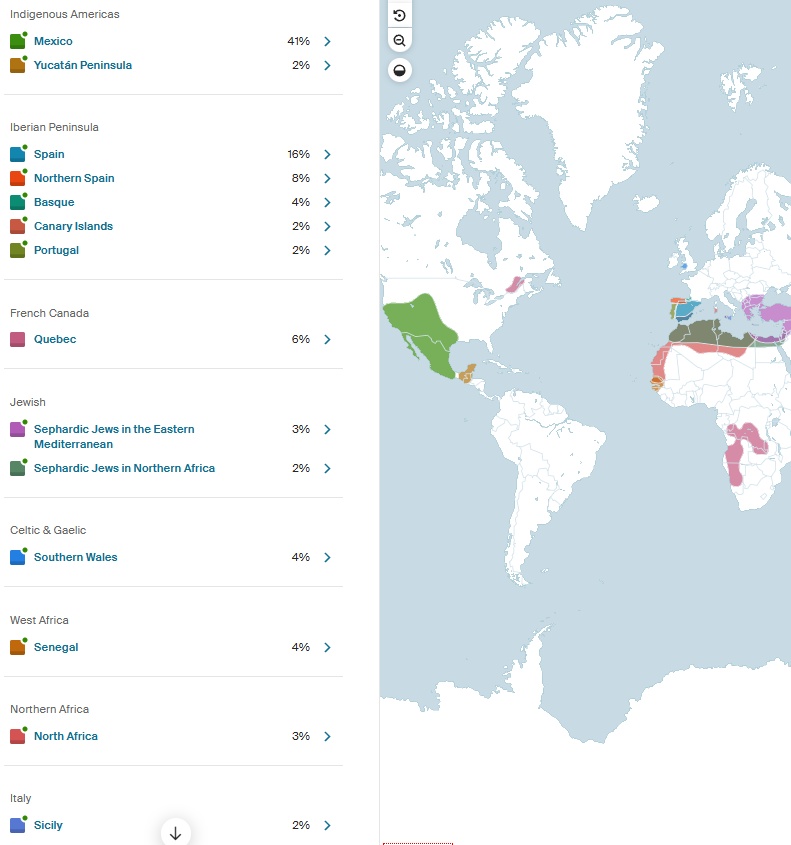
For a concrete illustration, I can offer my own results. My AncestryDNA breakdown came back around 41% Indigenous Mexican, with the rest a spread of Spanish, Northern Spanish, Basque, a bit of Sephardic, some West African, and assorted European traces. That is a fairly ordinary mestizo profile. The single largest component of my ancestry is Indigenous American, and I would guess most Mexicans who test are at least mildly surprised to find the same, having grown up thinking of themselves simply as “Mexican” rather than as anything with a percentage attached.
The Part Almost Nobody Mentions: Indigenous Mexico Is Not One Thing
Here is the fact that separates a real answer from a lazy one.
“Indigenous Mexican” is not a single genetic category. It is dozens of distinct populations, and some of them are startlingly different from each other. One influential genome-wide study found that certain Indigenous Mexican groups are as genetically differentiated from one another as Europeans are from East Asians. Sit with that for a second. The genetic distance between, say, the Seri of the northern desert and the Maya of the Yucatán can rival the distance between a Swede and a Han Chinese.
Why? Geography and time. Mountain ranges, deserts, and jungle kept populations relatively isolated for thousands of years, and that isolation let genetic drift accumulate. The result is that Mexico holds one of the largest reservoirs of pre-Columbian genetic diversity anywhere in the Americas, and that ancient substructure is still visible in the DNA of modern mestizo Mexicans. Researchers can often pin the Indigenous portion of a mestizo genome to a surprisingly specific region of the country.
So “are Mexicans Native American” flattens something that is actually a rich, structured map. The Indigenous ancestry is not a single beige block. It is Zapotec and Nahua and Purépecha and Maya and Rarámuri, populations with their own deep histories, carried forward in different proportions by different people.
How They Got There: The Bering Strait and the Deep Backstory
To connect this to the wider Native American story, it helps to rewind well before Mexico existed as an idea.
The peopling of the Americas traces back to a population that crossed from Siberia into the Americas during the last Ice Age, when lower sea levels exposed Beringia, the land bridge where the Bering Strait now sits. These first Americans pushed south over millennia, spreading through North America, into Mesoamerica, and all the way down to the tip of South America. The Indigenous peoples of Mexico descend from that southward expansion.
This shared origin is why Native American populations across both continents, from the Arctic to Patagonia, carry related genetic markers and the same handful of founding maternal lineages. The Maya farmer and the Plains hunter are branches of the same ancient migration, separated by thousands of years of divergence after their ancestors entered the Americas. It is the same reason the “are Native Americans Asian” question keeps coming up, and the answer there is a careful no: they descend from an ancient population connected to the peoples of northeast Asia, but they became something genetically distinct during a long period of isolation after crossing. Related at the root, separate at the branch.
For the Mexican question, the takeaway is simple. The Indigenous ancestry in a mestizo Mexican genome is not some minor local ingredient. It is a direct line back to the original human settlement of the hemisphere, tens of thousands of years deep.
The Legal Question: Why DNA Doesn’t Make You “Native American” in the US
This is where a lot of well-meaning confusion lives, so it is worth being precise.
In the United States, being “Native American” in the legal and political sense means being an enrolled member of a federally recognized tribe. Enrollment criteria are set by each tribe, and they typically involve documented descent from a specific historical membership roll, sometimes combined with a blood quantum threshold. It is fundamentally a political status, closer to citizenship in a nation than to a genetic test result.
That is why a person can have 60% Indigenous American DNA and still not be “Native American” in any legal sense recognized by the US government, while another person with a much smaller Indigenous percentage can be an enrolled tribal member. The law is not tracking ancestry percentages. It is tracking membership in specific sovereign nations.
Mexico’s Indigenous peoples belong to their own nations and communities, most of which sit inside Mexico and have no relationship to the US federal recognition system. So a Nahua or Maya person is unambiguously Indigenous, and unambiguously Native American in the ancestral sense, while still falling entirely outside the US legal category of “Native American.” Different countries, different systems, different meanings of the same English phrase.
There is also a real, living population of Indigenous Mexican Americans in the US, people from Oaxacan and other communities who speak Mixtec, Zapotec, or other Indigenous languages and who identify with their specific nation rather than with the blanket labels “Hispanic” or “Latino.” They complicate the tidy US categories in useful ways, and they are frequently subjected to discrimination from non-Indigenous Latinos, which tells you the distinction is very much alive on the ground.
This is also where the “Hispanic” and “Latino” labels muddy the water further. Both are ethnicity or origin categories, not ancestry, and on the US Census “Hispanic” is explicitly not a race. A Mexican American can mark Hispanic origin and then, in the race question, select American Indian, and many with strong Indigenous ancestry would be entirely accurate to do so, though most historically have not, defaulting to “some other race” or white instead. The gap between how Mexicans could classify themselves and how they actually do is one of the more interesting quirks in US demographic data, and it comes straight out of the identity history below.
The Yaqui: When the Border Runs Through a People
The clearest illustration of how tangled this gets is the Yaqui. The Yaqui are an Indigenous people whose traditional homeland sits in Sonora, in northern Mexico, but who also live north of the border, and the Pascua Yaqui Tribe in Arizona is a federally recognized US tribe. Same people, same ancestry, same language, split by a border drawn straight through them in the 19th century. A Yaqui on the Arizona side can be “Native American” in the full US legal sense, while a Yaqui cousin in Sonora is “Mexican,” despite there being no ancestral difference between them at all. If you want a single example that shows how much the label depends on which side of a political line you happen to stand on, that is it.
The Identity Question: What People Call Themselves
Ancestry and law aside, there is the simple matter of how people see themselves, and here Mexico’s own history matters.
After independence, Mexico built a national identity heavily around the idea of mestizaje, the blending of Indigenous and Spanish into a unified Mexican people. That framing had real effects. It encouraged many Mexicans with overwhelmingly Indigenous ancestry to think of themselves as mestizo or simply Mexican rather than as Indigenous, and it pushed Indigenous languages and identities toward the margins. Someone can be genetically 80% Indigenous and culturally, linguistically, and by self-conception thoroughly mestizo, because that is the identity the nation was built to produce.
At the same time, millions of Mexicans do identify as Indigenous, belong to specific communities, speak their languages, and maintain distinct traditions. And during the Chicano movement in the US, many Mexican Americans reclaimed an explicitly Indigenous self-understanding, invoking Aztec and Maya heritage as a source of pride and political identity.
So “do Mexicans identify as Native American” has no single answer. It runs from people for whom Indigenous identity is the center of their life to people for whom it is a fact about their DNA they had never much considered. Both are authentically Mexican.
So, Are Mexicans Native American?
Put it all together and the honest answer is a layered yes-and-no.
By ancestry, most Mexicans are substantially Native American, often majority so, descended from the Indigenous peoples of Mexico who trace back to the original peopling of the Americas. By US legal definition, most are not, because that category is about tribal enrollment, not DNA. By identity, it varies from person to person and always has.
The reason the question feels slippery is that it smuggles three separate questions inside one phrase, and people answer whichever one they were already thinking about. Genetics, law, and identity are three different maps of the same territory, and they do not line up neatly, because they were never drawing the same thing.
What is not in doubt is the ancestry itself. The Indigenous heritage of Mexico is deep, diverse, and genetically vivid, structured into dozens of distinct populations, some as different from each other as continents apart, and it is carried today by the majority of Mexicans whether they think about it daily or never at all.
Frequently Asked Questions
Are Mexicans considered Native American? By ancestry, most Mexicans carry significant Native American heritage and are Native American in the sense of descending from the Indigenous peoples of the Americas. By US legal definition, they generally are not, because that status requires enrollment in a federally recognized tribe. The two answers do not contradict each other; they use different definitions of the same term.
Do Mexicans have Native American DNA? Yes. Genomic studies consistently show that mestizo Mexicans carry substantial Native American ancestry, frequently around half and often more. The maternal line, tracked through mitochondrial DNA, is overwhelmingly Native American in most Mexicans, reflecting the sexually asymmetric admixture of the colonial period.
Are Mexicans and Native Americans the same? They share deep ancestry, since the Indigenous peoples of Mexico and those of the US and Canada all descend from the same ancient migration into the Americas. But “Mexican” is a national identity encompassing many ancestries, while “Native American” in US usage refers to enrolled tribal nations. Overlapping roots, different categories.
Why do Mexicans and Native Americans look similar? Because many share Indigenous American ancestry tracing to the same founding population that entered the Americas from Siberia during the last Ice Age. The physical similarities reflect that common ancestral origin.
Are Mexicans indigenous? Some Mexicans are Indigenous in the full sense, belonging to specific communities and often speaking Indigenous languages. Many more carry substantial Indigenous ancestry while identifying as mestizo, a product of Mexico’s national emphasis on blended identity. Genetically, Indigenous ancestry is common; whether someone identifies as Indigenous is a separate matter.
What is a mestizo? A mestizo is a person of mixed Indigenous American and European ancestry, the demographic majority in Mexico. The term reflects both a genetic reality and a cultural identity that Mexico built its post-independence national story around.
Where does the Indigenous ancestry of Mexicans come from? From the Indigenous peoples of Mexico, including the Nahua, Maya, Zapotec, Mixtec, Purépecha, Otomí, and many others, who themselves descend from the population that first settled the Americas after crossing the Beringian land bridge. Modern genetic studies can often trace the Indigenous portion of a mestizo genome to specific regions of Mexico.
Are all Indigenous Mexican groups genetically the same? No, and this is one of the more remarkable findings in the field. Some Indigenous Mexican populations are as genetically different from one another as Europeans are from East Asians, the result of thousands of years of relative isolation across mountains, deserts, and jungle. Mexico holds some of the greatest pre-Columbian genetic diversity in the Americas.